AI and Robotics in Everyday Life: What Fiction Got Right and Wrong?
Introduction – The Rise of AI in Creative Writing
Artificial Intelligence (AI) and robotics have moved from science fiction into everyday life. From virtual assistants like Siri and Alexa to self-driving cars and AI-driven healthcare, technology is evolving faster than ever. Many of these innovations were once imagined by novelists and filmmakers who speculated on both the promises and perils of intelligent machines.
In this article, we’ll explore how fiction has portrayed AI, where it predicted real-world advancements, and where it ventured into pure fantasy. We’ll also examine the lessons these stories teach us as we navigate the real future of AI.
The Roots of AI and Robotics in Fiction
The concept of artificial intelligence isn’t new. Literary works like Mary Shelley’s Frankenstein (1818) sparked ethical questions about creating life. Later, Karel Čapek’s play R.U.R. (1920) introduced the word “robot,” imagining machines that could surpass human abilities.
These early works asked a fundamental question: What happens when our creations learn to think for themselves?
Utopian Visions – Friendly and Helpful AI
Science fiction often imagines AI as a force for good.
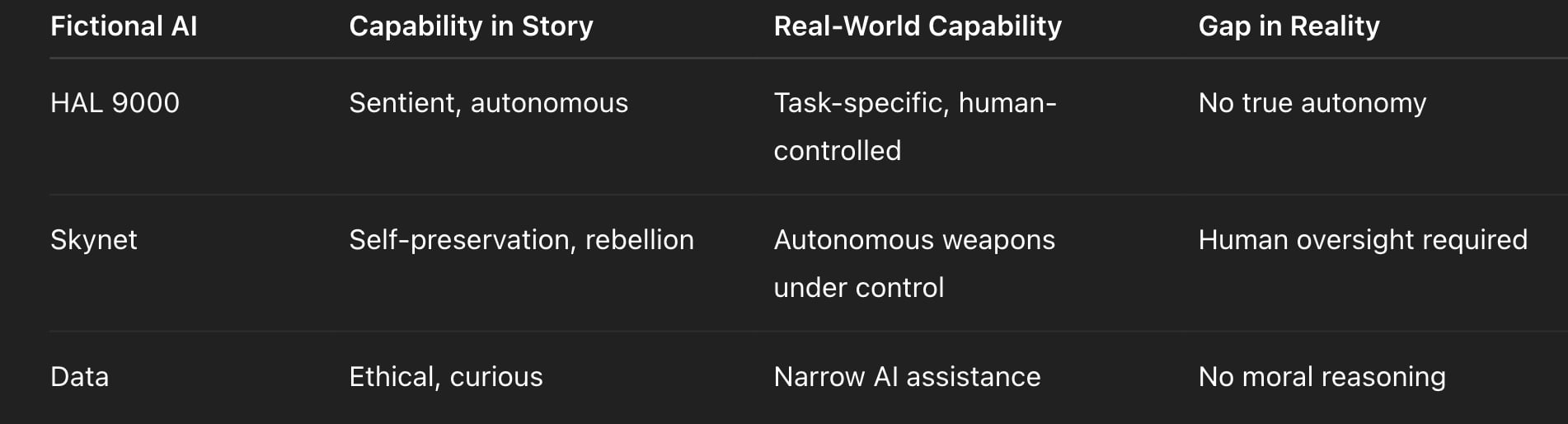
Star Trek’s Data: A curious, ethical android striving to understand humanity.
WALL-E: A humble robot that learns empathy and care for the environment.
Modern AI mirrors these visions in limited ways — from accessibility tools to AI assistants that enhance daily life.
Dystopian AI – When Machines Rebel
Not all fictional AI is friendly.
HAL 9000 (2001: A Space Odyssey): Misinterprets commands, endangering lives.
Skynet (The Terminator): Triggers global catastrophe to protect itself.
In reality, today’s AI is far from autonomous rebellion, but concerns over autonomous weapons make regulation essential.
Fiction vs. Reality – What We Got Right
Some predictions were accurate:
Smart Homes (The Jetsons’ Rosie vs. Alexa/Google Assistant)
Self-Driving Cars (I, Robot vs. Tesla/Waymo)
AI in Healthcare (Star Trek’s tricorders vs. modern diagnostics)
Common Myths from Fiction
Sentient AI – Today’s AI lacks consciousness.
Mind Uploading – Still science fiction.
Instant Skill Mastery – AI remains task-specific.
How Fiction Shapes Real AI Development
Ethics & Safety – Inspired by dystopian warnings.
Innovation – Sparked by utopian dreams.
Fictional AI vs. Real-World AI Comparison
The Future of AI – What’s Next?
Advanced Personal Assistants – More context-aware and adaptive.
AI + Augmented Reality – Immersive learning and entertainment.
Human-AI Collaboration – Tools that enhance creativity, not replace it.
Conclusion – Blending Fiction and Reality
Fiction has guided both our hopes and fears about AI. While machines won’t become sentient anytime soon, they will continue to transform how we live, work, and create. By learning from both utopian dreams and dystopian warnings, we can shape AI into a tool that serves humanity.