AI vs. Human Creativity in Writing: Can Artificial Intelligence Really Be Creative?
Introduction: The Rise of AI in Understanding Creativity
Imagine a world where your favorite novel was authored by a machine. Would it still move you? As artificial intelligence advances rapidly, it no longer simply computes—it creates. AI tools like OpenAI’s ChatGPT and DALL‑E now write poems, compose essays, and generate visual artwork. This has sparked an age-old debate: can machines truly understand creativity, or do they merely replicate it?
This guide explores the real differences between human and machine creativity, backed by expert analysis and practical examples.
Human Creativity: Purpose, Emotion, and Experience
Creativity in humans is deeply tied to memory, emotion, and perspective. Oxford defines creativity as “the use of imagination or original ideas to create something.” But humans do more than assemble facts—they tell stories driven by feelings.
A human poet grieving a loss writes from lived pain. That emotion carries into their work, resonating with readers on a personal level.
AI Creativity: Patterns, Data, and Probability
AI systems, by contrast, generate content based on algorithms. Tools like GPT‑4 are trained on massive datasets, recognizing patterns in language. When asked to write a poem or a story, the machine calculates the most probable output—without feeling anything. While its output may sound moving, AI lacks genuine emotional intent.
“AI doesn’t imagine. It predicts.” — Bernard Marr, Forbes
How Generative AI Creates Content
Generative AI operates using models like neural networks and transformers.
ChatGPT and GPT‑4: How AI Writes
ChatGPT, developed by OpenAI, uses GPT‑4—a transformer model trained on massive amounts of internet text. It mimics human language through prediction and pattern-matching.
DALL‑E: Creating Visual Art from Text
DALL‑E works by interpreting descriptive prompts to generate original images. It “remixes” what it learned from millions of pictures to create something visually new, but not emotionally original.
Comparing Human vs Machine Creativity
Core Differences and Limitations
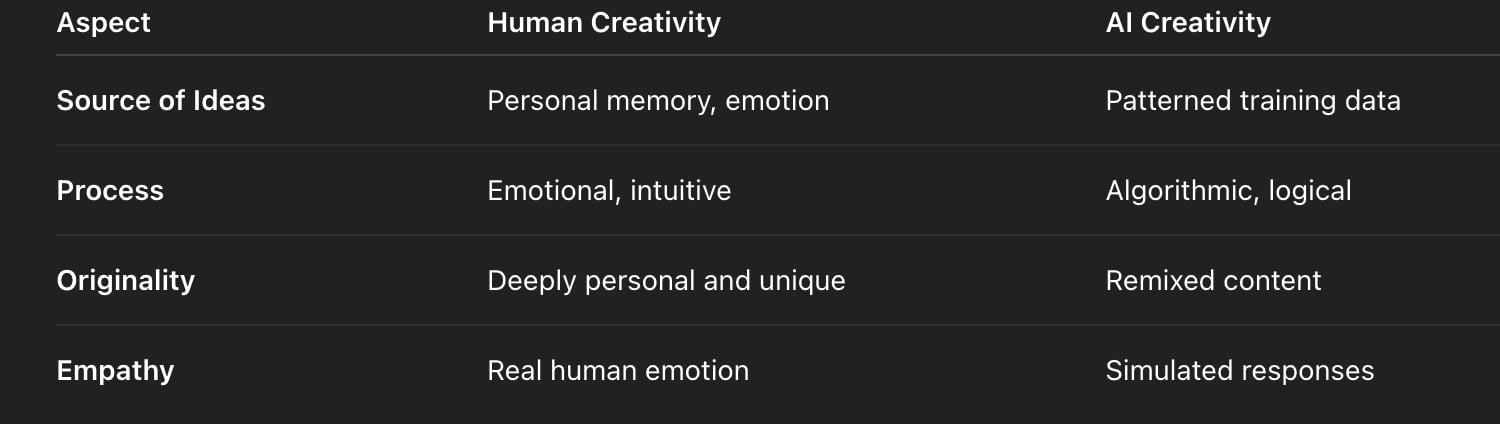
Let’s break it down:
Table: Human vs AI Creativity
Can AI Truly Create New Ideas?
According to a Stanford University study (2021), AI lacks experiential memory. It can combine existing data in novel ways, but doesn’t have original “thoughts.” Unlike a person who connects concepts emotionally and culturally, AI cannot create meaning—it mimics it.
Example: ChatGPT’s Haiku on Sunrise
Golden orb ascends, Warmth embraces earth below, Life awakes with light.
Though elegant, this poem is statistical guesswork—not soulful reflection.
DALL‑E: Creating Visual Art from Text
DALL‑E works by interpreting descriptive prompts to generate original images. It “remixes” what it learned from millions of pictures to create something visually new, but not emotionally original.
Is AI Redefining What Creativity Means?
LAs AI evolves, our definition of art might shift—just as photography once did. But even then, true innovation and expression will likely remain rooted in the human experience.
Future Trends in AI-Driven Creative Industries
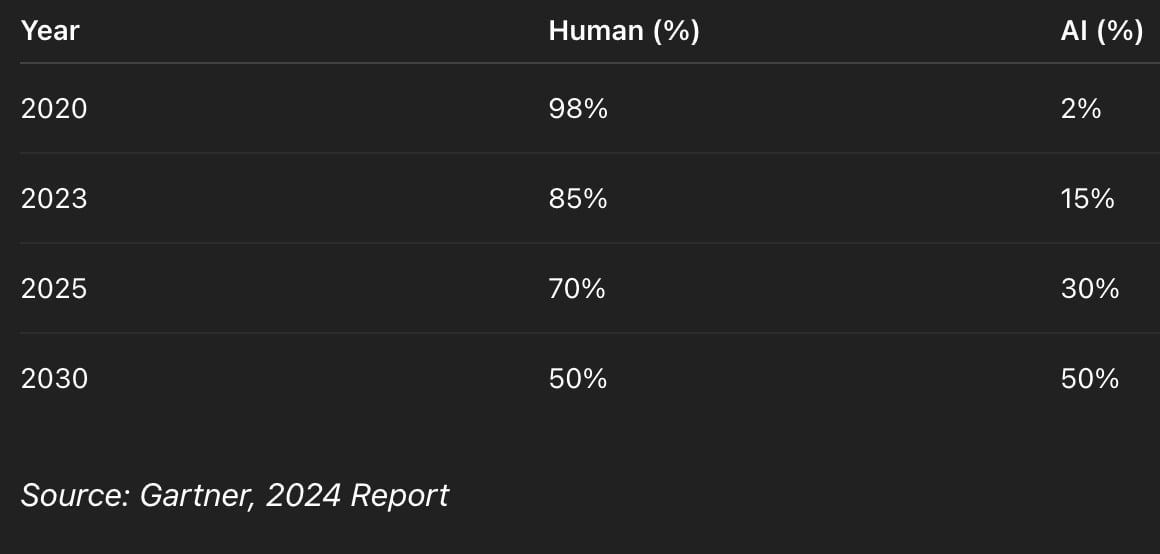
Content Growth Projections: AI vs Human
LAs AI evolves, our definition of art might shift—just as photography once did. But even then, true innovation and expression will likely remain rooted in the human experience.
AI in Creative Collaboration: Tool or Threat?
Writers and Artists Using AI Today
Rather than replacing artists, AI acts as a creative partner. Writers use it to generate drafts, brainstorm plots, or refine structure—enhancing rather than replacing creativity.
Conclusion: Human Experience Still Reigns Supreme
AI may be faster and impressively accurate—but it’s not alive. True creativity flows from experience, memory, and emotion. As we enter the AI era, our humanity becomes even more valuable.
Frequently Asked Questions
1. Can AI truly be creative like humans?
AI can simulate creativity, but it lacks emotion and lived experience—making its output imitation, not true innovation.
2. How does AI generate creative content?
AI uses algorithms to predict word or image sequences based on past data. It doesn’t imagine or feel.
3. Are AI tools replacing human writers?
Not yet. AI is often used as a writing assistant or brainstorming tool by professionals.
4. What are the risks of using AI in creative fields?
Plagiarism, loss of originality, and ethical concerns about authorship are key risks.
5. How do I optimize AI-generated content for SEO?
Use structured headings, include outbound links, optimize keywords and alt tags, and edit for tone and grammar.
6. Will AI change our definition of art?
It already is. However, most experts believe human emotion will remain the core of true art.