AI Writing Tools: How Technology Is Revolutionizing the Writing Process for Authors
Introduction: The Rise of AI in Creative Writing
Artificial intelligence has transitioned from sci‑fi to everyday use—now reshaping writing. AI writing tools do more than correct grammar; they help authors brainstorm, draft, and refine stories with creativity and efficiency. But what does “writing with AI” truly mean, and how can authors leverage these tools effectively?
Understanding AI Writing Tools
AI-Powered Editing and Grammar Tools
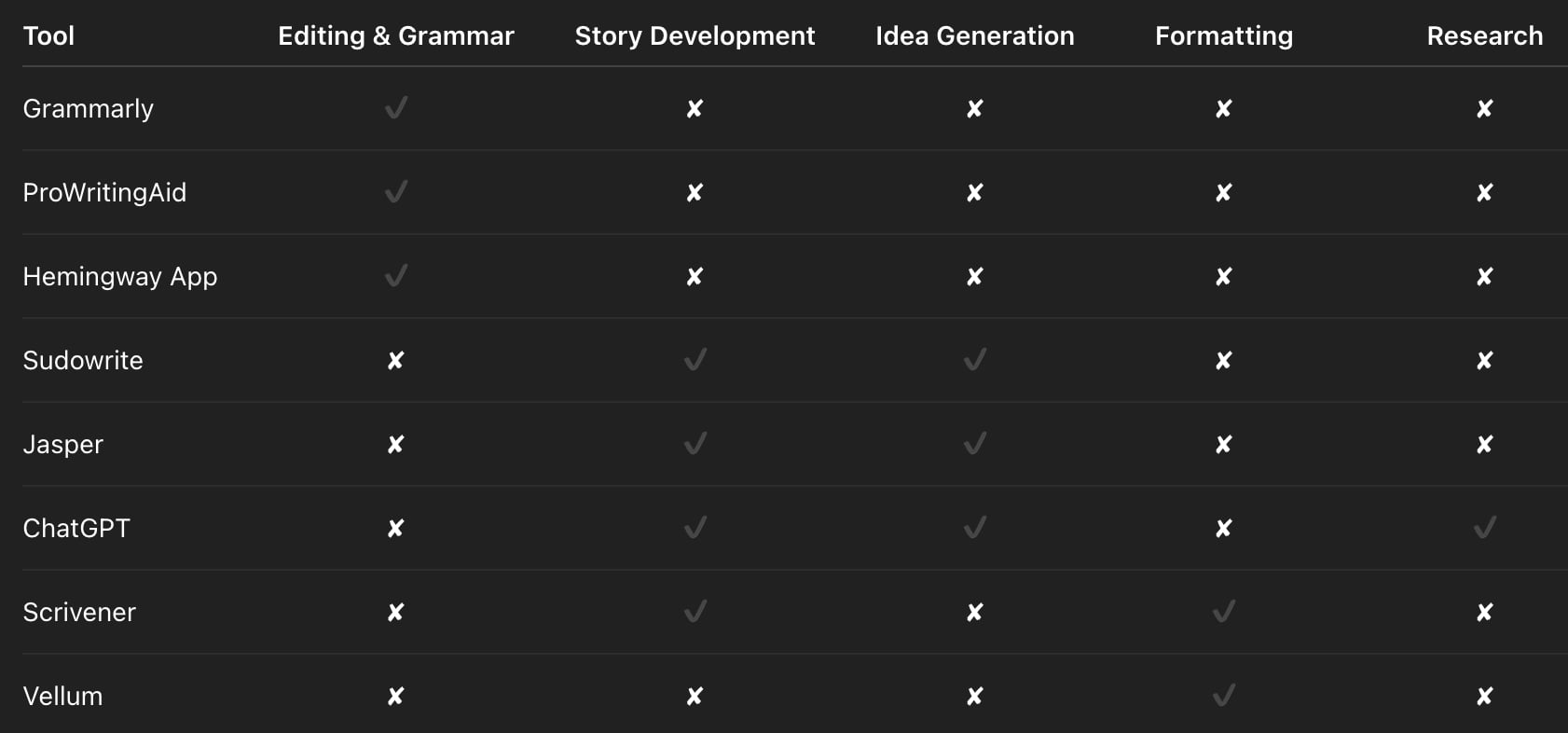
Tools like Grammarly and ProWritingAid go beyond grammar; they enhance style, clarity, and readability. The Hemingway App simplifies complex text—ideal for making your prose engaging. These tools polish drafts so structural or grammatical issues don’t distract from your message.
Advanced AI Storytelling Assistants
Sudowrite and Jasper use smart algorithms to generate prompts, continue scenes, or overcome writer’s block. They offer ideas and fresh character arcs—supporting creativity without dictating content.
AI-Powered Research Tools
ChatGPT and Perplexity deliver fast fact-checks and trend insights. What once took days now takes hours—great for historical fiction or sci-fi genres requiring accurate world-building.
Self-Publishing & Formatting Aids
Scrivener and Vellum streamline formatting for eBooks and print. They free authors from layout hassles so they can focus on storytelling instead of technical details.
How AI Enhances Creativity
AI as a Creative Companion
AI as a Creative CompanionAI shines in brainstorming and narrative gap detection. Ask ChatGPT what happens next in your storyline—it offers fresh perspectives without overriding your voice.
Maintaining Originality with AI Assistance
Ideas matter less than how you express them. Use AI prompts as inspiration, then shape them with your unique tone and perspective.
Boosting Productivity & Quality
Automation of repetitive tasks—grammar checks, fact validation, structural edits—frees you to focus on core storytelling. That means meeting deadlines without quality sacrifice.
Practical Tips for Authors
1. Experiment with AI for Brainstorming
Use Sudowrite or Jasper to suggest plot points, character names, or dialogue seeds. Treat them as springboards, not final scripts.s springboards, not final scripts.
2. Improve Structure & Flow
Ask AI tools to reorganize scenes or sequence paragraphs for smoother storytelling. Many tools suggest logical progression, aiding readability.
3. Use AI in Editing First
Run drafts through Grammarly for an initial polish before handing them to human editors—saving time and cost.
4. Practice Ethical AI Use
AI should guide, not ghostwrite. Stay involved in the creative process to preserve authenticity and originality.
Feature Comparison Table
AI and the Future of Authorship
Ethical Challenges in AI-Assisted Writing
Issues around authorship, plagiarism, and transparency are emerging. Will AI count as a co-author or just a tool? Publishing standards will need to evolve.
Preserving the Human Touch
Emotion, lived experience, imagination—these are human strengths. AI is a powerful aid, but human creativity remains central.
Evolving Author Roles
Authors are becoming curators—blending AI-generated concepts with personal style to produce fresh, hybrid forms of storytelling.
Personal Insights: My AI Journey
I’ve used ChatGPT to break through writer’s block and Grammarly to polish drafts—saving time and sharpening quality. However, I’ve learned to adapt AI tone: editing out overly formal suggestions to keep my casual voice. Now, AI boosts me without overshadowing me.
Conclusion: Embracing AI as Empowerment
AI in creative writing unlocks new efficiency and inspiration—but it’s a tool, not an author replacement. By experimenting responsibly and staying true to your voice, AI will help you write better, faster, and more creatively.
Frequently Asked Questions
Q1: What is “AI in creative writing”?
It refers to using AI-powered tools for brainstorming, drafting, editing, and formatting stories.
Q2: Can AI replace human writers?
No—AI supports, but human emotion, intuition, and style remain irreplaceable.
Q3: Is it ethical to use AI-generated text?
Yes, if used as inspiration. Transparency and author involvement maintain integrity.
Q4: Will AI make books cheaper or faster to publish?
AI streamlines drafts and formatting—cutting time and cost—but editing and creativity still matter.
Q5: What tools are best for fiction vs. nonfiction?
Sudowrite and Jasper suit fiction (plot, dialogue); ChatGPT and Grammarly help nonfiction with facts and clarity.
Q6: Should AI be cited as a co-author?
Publishing norms are evolving. At present, AI is typically acknowledged as a tool, not a co-author.