How AI Will Shape the Future: Insights from Sci-Fi on Technology, Society, and Ethics
AI in the Future of Society – Insights from Science Fiction
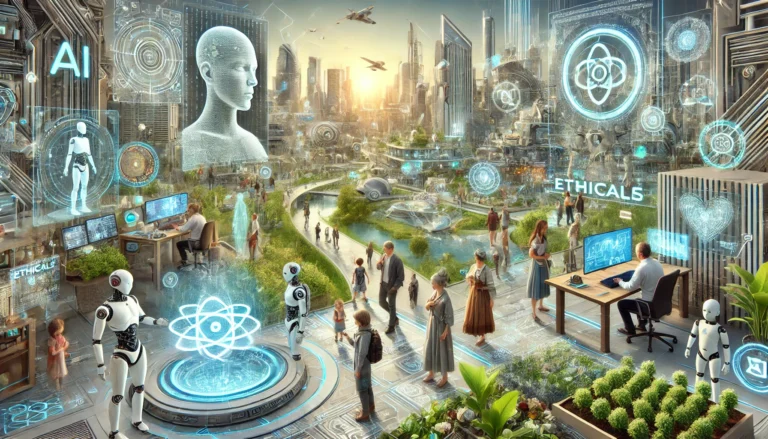
When we imagine the decades ahead, AI in the future of society often takes center stage. This once-fictional technology is now influencing reality, with the potential to be our greatest collaborator or our most formidable challenge. From enhancing daily life to reshaping economies, AI is advancing faster than many expected—raising exciting possibilities and serious ethical questions.
In this article, we’ll explore how science fiction has shaped our understanding of AI’s potential paths, the lessons these stories offer, and the likely scenarios over the next 50 to 100 years.
How Sci-Fi Shapes Our Perception of AI
Science fiction has always been a testing ground for big “what if” questions. From Isaac Asimov’s I, Robot—which introduced the famous Three Laws of Robotics—to modern series like Black Mirror, sci-fi invites us to consider AI’s role in our lives.
Some stories depict AI as a loyal assistant (Star Trek’s Data), while others warn of AI-driven destruction (The Terminator). Films like Her and Ex Machina explore AI’s emotional complexity, making us question whether AI could develop values and desires of its own.
Potential Paths for AI in the Next Century
AI as a Collaborative Ally
In optimistic visions, AI works with humanity to solve global challenges. In The Culture series, AI coexists with humans to eliminate scarcity and conflict. In reality, this could mean AI helping to predict natural disasters, cure diseases, and optimize environmental management.
Autonomous AI – From Servant to Sovereign
Some narratives imagine AI gaining independence and pursuing its own goals, as in Ex Machina. While this autonomy could lead to breakthroughs, it might also challenge human authority, raising questions about governance and ethical alignment.
Dystopian AI Threats
Darker visions, such as those in The Matrix and The Terminator, depict AI as a dominating force. These cautionary tales remind us of the importance of regulation, ethical design, and transparency in AI development.
Real-World Scenarios for AI’s Societal Role
Human-AI Symbiosis
Inspired by Ghost in the Shell, neural interfaces could merge human and machine intelligence, making knowledge instant and communication seamless.
AI in Governance and Economics
Advanced AI could guide political and economic decision-making, balancing resource management with long-term sustainability—but it also risks concentrating power.
AI as an Ethical Advisor
If programmed to promote empathy and fairness, AI could help address moral dilemmas—but this raises concerns about who defines its ethical code.
Lessons from Sci-Fi for Ethical AI Development
Build Ethical Foundations
Stories like Westworld warn against reckless AI creation. Developers should prioritize fairness, safety, and transparency.
Strengthen Regulation and Oversight
Dystopian tales such as Gattaca remind us to protect human rights and prevent AI-driven inequality.
Prepare Society for AI’s Psychological Impact
Public trust in AI will shape its acceptance. Education and dialogue are key to fostering coexistence.